The Archivist's Afternoon
The Box That Came Down from the Loft
Need to read the writing on the back of old photos? Swoosh does it: photograph the faded pencil and fountain-pen captions, and they come back as clean, typed text you can search and keep. Here is how to turn an unlabelled box into a named, searchable family archive in an afternoon.
It is a shoebox, or a biscuit tin, or one of those stiff old chocolate boxes with a faded ribbon. Inside, photographs. Hundreds of them, loose, in no order anyone living can explain. Sepia giving way to the slightly sour colour of the seventies. Crimped white borders. A few studio portraits on thick card, stamped on the back with the name of a photographer in a town you have never been to.
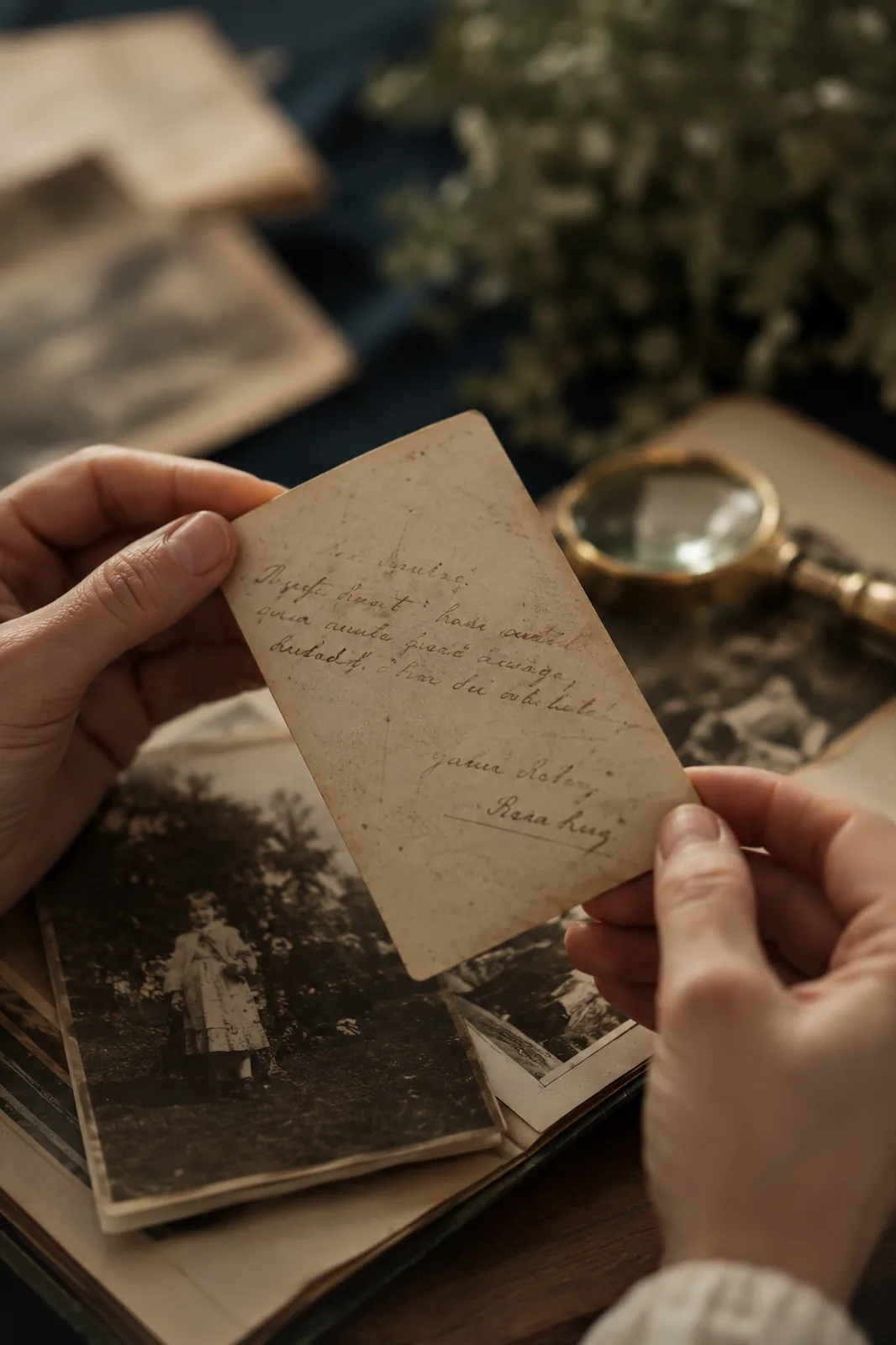
You sit on the floor with the box between your knees and start turning them over. And there, on the back of many of them, in pencil or fountain pen, is the thing you were hoping for. A name. A date. A place. Written by someone who knew exactly who these people were, and who took a moment to make sure you would too.
The trouble is that the someone is gone, and so is the certainty. You can read most of the captions. But the box is heavy, the writing is small and faded, and you know that if you simply close the lid and put it back in the loft, the day will come when nobody alive can put a name to a single face.
The Captions Are the Treasure, Not the Photos
It is worth saying plainly. The photographs are lovely, but it is the writing on the back that you cannot afford to lose.
A face without a name becomes a stranger in two generations. Your grandmother knew everyone in that box. Your mother knew most of them. You know some. Your children will know almost none, unless the names travel with the faces. And the names are right there, in a careful hand, waiting to be kept.
So before you sort, before you scan the fronts, turn the photographs over and read the backs. That is the archive. The rest is a picture album. This is the part that makes it your family's, specifically, and not just a box of old photographs that could belong to anyone.
How to Read the Writing on the Back of Old Photos
You could copy them out by hand. People do, and their wrists ache, and they give up around photograph forty with the best intentions of finishing next weekend.
Instead, photograph the backs. Lay the photograph face-down on a plain surface, somewhere with soft daylight from the side so the faded pencil does not disappear into glare. Fill the frame with the card. Then do the next one, and the next, building up a little run of images of the writing.
In short, it goes like this:
1. Lay each photograph face-down in soft, side-on daylight.
2. Fill the frame with the card and photograph the back.
3. Work through the box, building a run of images.
4. Drop them onto the handwriting tool to read the captions into typed text.
5. Export to a Word document or spreadsheet, each name beside its face.
What comes back is clean, typed text. The spidery fountain pen, the pencil gone silver with age, the careful capitals of someone who learned to write a century ago, all of it becomes words you can read at a glance and, more to the point, words you can search.
That last word is the whole game. Once the captions are text, you can find every photograph with a particular surname in it. You can pull together everyone from one summer, one wedding, one house. The box stops being a box and becomes something you can ask questions of.
Building the Record, Name by Name
Now you make the archive properly. Photograph the front of each picture too, and keep the front and the back together, the face and its name in one place. Paste the caption text in as the label. Export the whole thing to a Word document or a spreadsheet, whichever suits the way you think, and you have a record: image, name, date, place, line after line.
This is the afternoon's quiet pleasure. Reading the captions slowly, you find things. A maiden name you never knew. A baby identified who turns out to be the uncle you remember as an old man. A place name that explains a story your mother used to tell. The act of keeping the names makes you read them, and reading them brings the people a little closer.
When a caption is genuinely unclear, a smudged year, a place spelled the old way, a flourish that could be two different letters, it is flagged rather than guessed at silently. So you can hold the original up to the light and decide for yourself, which is exactly right, because you are the one who might just know.
Then it is kept. Not in a tin in the loft where only the boldest captions survive, but in a record you can search, copy and pass on. The photographs go back in their box, no longer the only thing standing between these faces and anonymity. The names are safe now, written down twice, in a hand from long ago and in plain type that anyone can read.
A Few Questions People Ask
Will it read very old or very faded handwriting?
That is exactly the case it is built for. Fountain pen, faded pencil and the long-tailed letters of an older hand are where ordinary scanning tools give up. It reads the shapes and the joins rather than matching each letter in isolation, and where a word is honestly unclear it flags it so you can check the original.
Can I keep the photo and its caption together?
Yes, and you should. Photograph both the front and the back, keep the two images side by side, and use the caption text as the label. Exported to a document or a spreadsheet, each face travels with its name, which is the entire point of the exercise.
Are the family photographs private?
To read the captions, the image is sent to a model that does the reading, and we do not keep your images or use them to train anything. Your family's faces and names stay yours. They do not become part of a dataset.
Got a box that needs naming? OCR photo captions, free to try.